
How Long Does Nano Ceramic Coating Last?
Table of Contents
- Nano Ceramic Coating Lifespan: Marketing Claims vs. Real-World Performance
- Key Factors Affecting Ceramic Coating Lifespan
- How Nano Ceramic Coating Degrades Over Time
- Signs Your Ceramic Coating Is Failing
- Ceramic Coating Maintenance Tips to Maximize Durability
- The Re-Application Process: When and How to Recoat
- Frequently Asked Questions
Last Updated: August 31, 2026
Nano Ceramic Coating Lifespan: Marketing Claims vs. Real-World Performance
Marketing materials promise five, seven, even ten years of protection. Real-world performance tells a more complicated story. At Liquid Armour USA, we believe you deserve the unvarnished version before you invest in a professional-grade coating.
Nano ceramic coating is a silica-based, nano-scale protective layer that bonds chemically to a vehicle's clear coat, forming a semi-permanent hydrophobic glass-like shield against UV damage, chemical contamination, and oxidation.
A properly applied professional-grade coating on a well-prepared surface, maintained correctly, realistically lasts two to five years (peer-reviewed research). DIY kits typically last one to two years. The gap between those figures and marketing claims is where most buyers get burned.
Below, we'll break down exactly why coatings degrade, what accelerates that process, and what genuine maintenance looks like.
DIY Kits vs. Professional-Grade Coatings: What the Numbers Actually Mean
The difference between consumer-grade DIY kits and professional-grade nano ceramic coatings comes down to silica dioxide concentration, layer thickness, and the controlled conditions under which the coating bonds to the surface.
DIY kits are formulated for ease of application with lower solvent concentrations and thinner film build, delivering one to two years of meaningful hydrophobic protection. Professional-grade coatings, applied by trained installers under controlled conditions, achieve a denser, more uniform bond with the clear coat, extending lifespan to two to five years or longer on garaged, meticulously maintained vehicles.
The 9H hardness rating on professional coatings refers to pencil hardness scale, the same standard used in the coatings industry to measure scratch resistance. A 9H-rated coating resists swirl marks and light abrasion far better than consumer alternatives, directly contributing to longevity.
Warranty vs. Actual Lifespan: Why These Are Not the Same Thing
A five-year warranty does not mean the coating will perform at its original level for five years. Warranties typically cover manufacturer defects in the product itself, not degradation caused by environmental fallout, improper maintenance, or incomplete paint preparation.
Read the fine print on any ceramic coating warranty and you will find conditions: annual inspections, mandatory use of pH-neutral maintenance products, proof of proper surface preparation before application. Fail any one of those conditions and the warranty is void. Actual lifespan is a function of how the coating is applied, where the vehicle lives, and how it is maintained. Warranty is a legal document. Do not conflate them.
Key Factors Affecting Ceramic Coating Lifespan
Understanding the factors affecting ceramic coating lifespan is the difference between a coating that lasts three years and one that fails in eighteen months. Surface preparation, application technique, and environmental conditions matter most.
Paint Preparation and Surface Decontamination
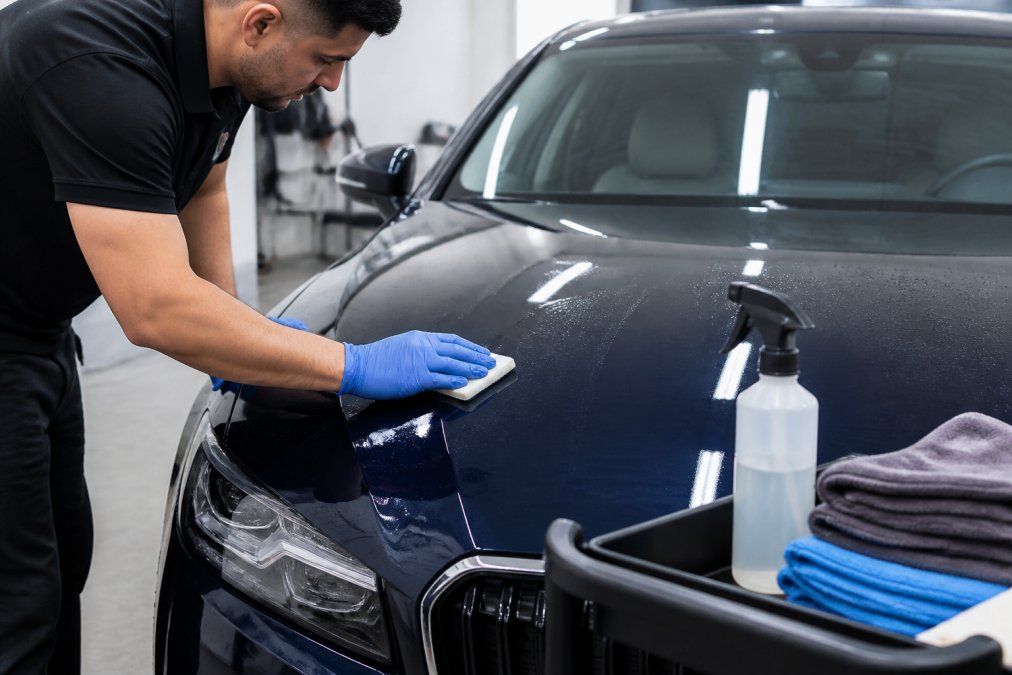
Poor paint preparation is the single most common reason ceramic coatings fail prematurely. A coating cannot bond properly to a surface contaminated with iron particles, tar, wax residue, or polishing oils.
Proper decontamination is a multi-stage process:
- Chemical decontamination using an iron fallout remover to dissolve embedded metallic particles
- Clay bar treatment to pull bonded surface contaminants
- Paint correction to address swirl marks, light scratches, and oxidation before coating
- Panel wipe-down with an isopropyl alcohol-based prep solvent to strip remaining oils or residue
Skipping any of these steps compromises the coating's bonding ability.
Application Technique and Curing Time
Application technique directly determines how uniformly the coating bonds across the panel. Nano ceramic coatings are solvent-based products; the carrier solvent must fully evaporate and the silica must cure before water or contamination exposure.
Common application mistakes that shorten coating lifespan include applying in direct sunlight, using too much product, insufficient curing time before water exposure, and skipping layering on high-wear areas. Layering increases film thickness and extends durability on surfaces that take the most environmental punishment.
Geographic Climate and Environmental Fallout
Where a vehicle lives significantly affects coating longevity. A vehicle garaged in a dry, mild climate will retain its coating's hydrophobic properties far longer than one parked outdoors in a coastal or high-UV environment.
Climate Type |
Primary Stressor |
Impact on Coating |
|---|---|---|
Coastal / saltwater |
Salt spray, humidity |
Accelerated degradation of hydrophobic layer |
Desert / high UV |
Intense UV radiation |
Faster gloss loss, oxidation risk to clear coat |
Northern / freeze-thaw |
Road salt, de-icing chemicals |
Chemical resistance tested repeatedly |
Urban / industrial |
Acid rain, industrial fallout |
Etching risk if maintenance is delayed |
Temperate / garaged |
Low environmental stress |
Maximum realistic lifespan achieved |
According to the American Chemical Society's research on environmental coating degradation, UV radiation and acidic precipitation are the two most aggressive external factors in polymer coating breakdown.
How Nano Ceramic Coating Degrades Over Time
Ceramic coating degradation is gradual, not a cliff-edge event. The hydrophobic properties and surface tension effects diminish gradually.
A Degradation Timeline: What Happens Year by Year
Year 1: The coating is at peak performance. Water beads aggressively and sheets off the surface. Chemical resistance is at its highest. Maintenance washes with pH-neutral soap are sufficient.
Year 2: Hydrophobic performance remains strong on well-maintained vehicles. Minor reduction in beading intensity may appear on high-impact areas. A ceramic top-up spray applied every three to four months can restore surface energy.
Year 3: This is the inflection point for most vehicles. Well-maintained, garaged vehicles continue performing. Vehicles exposed to heavy environmental fallout or irregular maintenance begin showing measurable degradation: water no longer sheets cleanly, and light contamination may bond more readily.
Year 4-5: Professional-grade coatings on optimally maintained vehicles can still deliver meaningful protection, though at reduced intensity. DIY coatings are typically well past their functional lifespan by year three. This is the window where re-application conversations should begin.
Beyond Year 5: Any coating claiming full performance beyond five years without documented maintenance records and ideal storage conditions should be treated skeptically.
Signs Your Ceramic Coating Is Failing
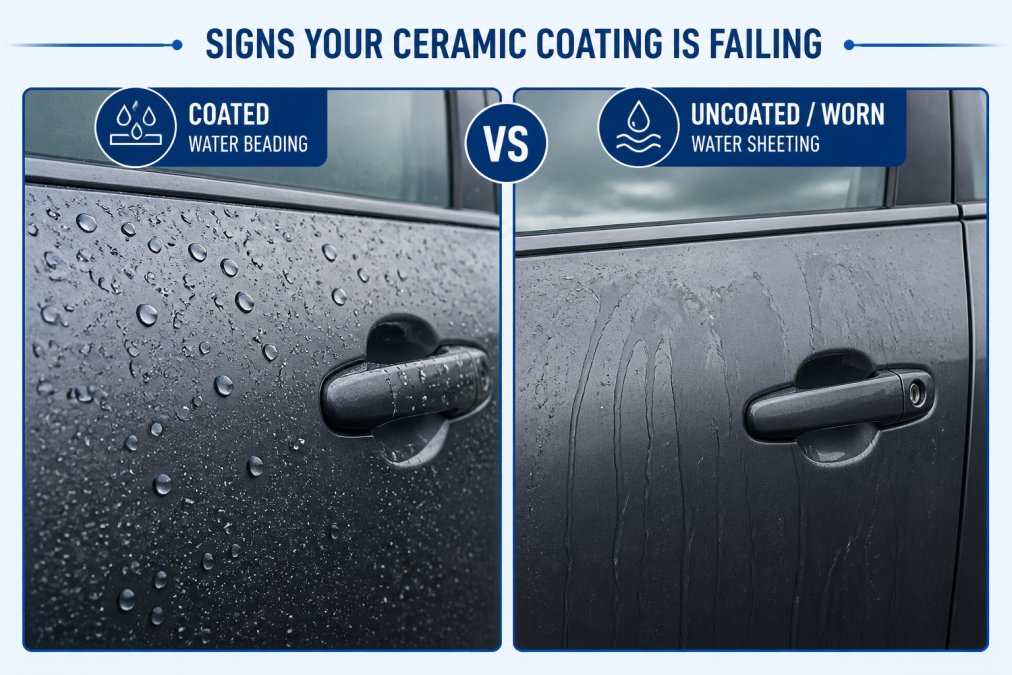
Ceramic coating failure has clear, observable indicators. Catching them early lets you address the issue with a top-up spray or targeted maintenance before full re-application becomes necessary.
Watch for these specific signs:
- Loss of water beading: Water stops forming tight, fast-moving beads and instead sheets flat or sits on the surface without moving.
- Increased water spot formation: Water spots that previously wiped off easily now etch into the surface.
- Contamination bonding: Bird droppings, tree sap, and industrial fallout that previously cleaned off now require more aggressive removal.
- Dull finish or reduced gloss: A noticeable reduction in depth and reflectivity suggests the silica layer is degrading.
- Swirl marks reappearing: If swirl marks become visible again, the coating film has worn through in those areas.
Ceramic Coating Maintenance Tips to Maximize Durability
Ceramic coating maintenance tips are not optional suggestions. They are the difference between a coating that reaches its full lifespan and one that degrades eighteen months early.
The most common maintenance mistake is using the wrong wash products. Alkaline or acidic wash solutions strip the coating's surface energy layer. pH-neutral soap is non-negotiable.
Core maintenance protocol:
- Wash with pH-neutral soap every two to three weeks, or more frequently in high-contamination environments
- Use the two-bucket wash method to prevent swirl marks
- Apply a ceramic top-up spray every three to four months to restore hydrophobic properties
- Address bird droppings, tree sap, and industrial fallout within 24 hours
- Avoid automatic car washes with abrasive brushes; touchless washes are acceptable
- Perform an annual decontamination wash using a pH-neutral iron fallout remover
According to the Society of Automotive Engineers' technical resources on surface protection, the frequency and chemistry of cleaning cycles are among the most significant controllable variables in protective coating longevity.
:::pro_tip A ceramic top-up spray is not a substitute for full re-application, but it is one of the most cost-effective ways to extend coating performance between years two and four. Apply it quarterly after a maintenance wash on a clean, dry surface. :::
The Re-Application Process: When and How to Recoat
Re-application is not a failure. It is the expected lifecycle of a ceramic coating.
When to recoat: The right time is when the coating's functional performance has degraded to the point where maintenance can no longer restore it. Practically, that means persistent loss of water beading, increased surface contamination bonding, and visible reduction in gloss. For most professional applications, this conversation begins at the three-to-five-year mark.
The re-application process:
- Full decontamination wash to remove all surface contamination and iron fallout
- Clay bar treatment to strip any remaining bonded contaminants
- Paint correction if swirl marks or light scratches have developed
- Panel wipe-down with an isopropyl alcohol-based prep solvent
- Application of the new coating using the same technique as the original installation
- Full curing period before water exposure
You cannot simply apply a new coating over a degraded old one and expect full performance. The old coating must be fully prepared before any new product goes on the surface.
The Liquid Armour USA professional installer network is trained specifically in both initial application and re-application protocols, ensuring the preparation work is done correctly. SGS-tested coatings applied by qualified installers give you a documented baseline for performance expectations and warranty compliance.
Protecting a vehicle's finish is a long-term commitment. The biggest challenge most owners face is managing the gap between what coatings promise and what they actually deliver under real conditions. Liquid Armour USA's professional-grade nano-ceramic coatings are formulated with 9H+ hardness and a hydrophobic self-cleaning effect designed to perform across automotive, marine, and industrial environments. Find an Installer through the Liquid Armour USA network and get the application done right the first time.
Frequently Asked Questions
How long does nano ceramic coating actually last compared to regular wax?
A quality nano ceramic coating applied by a professional typically lasts 2 to 9 years depending on preparation, climate, and maintenance. Traditional carnauba wax lasts 4 to 8 weeks before it breaks down and needs reapplication. The difference comes down to bonding: nano-ceramic coatings form a semi-permanent silica-based layer over the clear coat, while wax sits on top and washes away. For anyone paying monthly for wax services, a single professional ceramic coating application covers multiple years.
What destroys ceramic coating fastest?
The biggest threats to ceramic coating durability are harsh chemical exposure, improper washing technique, and neglected maintenance. Using non-pH-neutral soaps, automatic brush car washes, and acidic fallout from industrial areas all accelerate bonding breakdown. UV exposure in high-sun climates also degrades the hydrophobic layer faster than shaded environments. Skipping top-up spray treatments between annual maintenance washes removes the sacrificial layer that protects the base coating, shortening its effective lifespan significantly.
Does professional-grade nano ceramic coating last longer than a DIY kit?
Yes, consistently. Professional-grade coatings use higher concentrations of nano-ceramic and silica compounds, require controlled application conditions, and are layered for greater thickness and 9H hardness. DIY kits are formulated for easier self-application, which means lower solvent concentration and thinner bonding. A professional installer also performs full paint correction, clay bar decontamination, and surface preparation steps that most DIY users skip. Those preparation steps directly determine how well the coating bonds and how long it holds.
How can I tell if my ceramic coating has worn off?
The clearest sign is a loss of the beading effect: water that once rolled off in tight droplets now sheets flat across the surface. Other indicators include increased dirt adhesion after washing, visible swirl marks reappearing, reduced gloss depth, and paint that feels rough rather than slick to the touch. If a maintenance wash no longer restores the hydrophobic response, the coating has likely degraded past the point where a top-up spray can revive it, and recoating should be considered.
This article was written using GrandRanker